How the Kardashev scale works
Three rungs, each about ten billion times the last, and a simple formula that lets you sit between them.
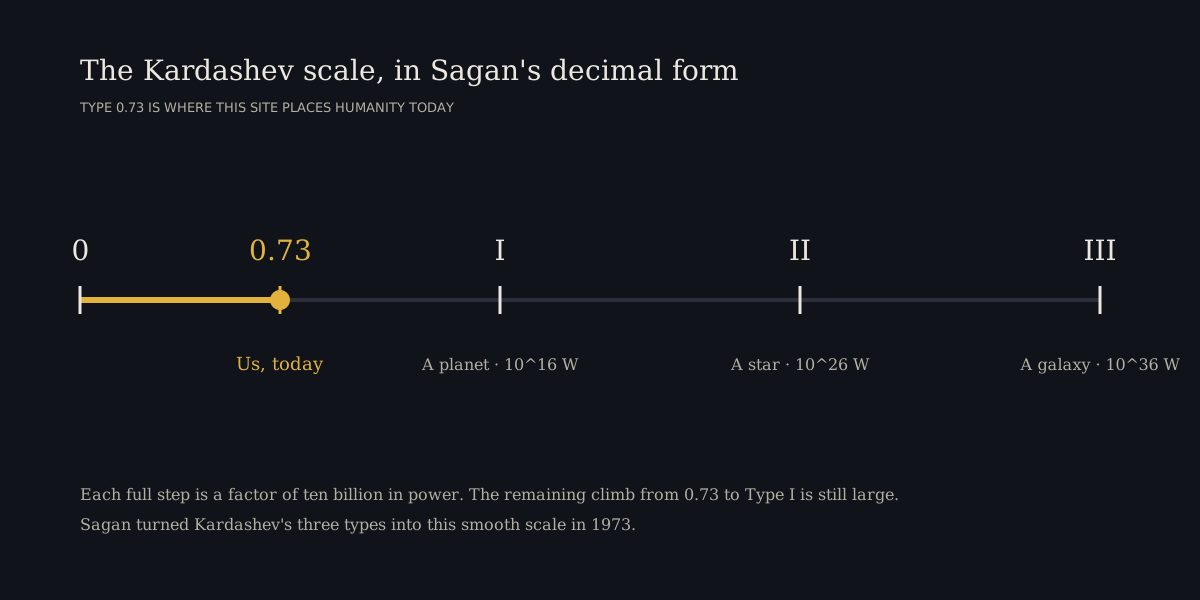
The original three rungs
Nikolai Kardashev's 1964 paper ranked civilizations by power. Type I was planetary. Type II was stellar. Type III was galactic. Later writers often place those rungs at about 10^16, 10^26, and 10^36 watts. The exact original figures were given in a different unit, but the idea is the same: each step is not a modest upgrade. It is a change in which object you are drawing on, from a planet to a star to a galaxy.
That is why the scale is useful as a sketch and easy to misuse as a forecast. It tells you the size of the jumps. It does not tell you how long a jump takes, or whether a society will try it.
Sagan's decimal scale
Carl Sagan, in The Cosmic Connection (1973), turned the three types into a continuous scale so that a civilization could be given a fractional type. The formula used on this site is K = (log10(P) - 6) / 10, where P is power in watts and K is the type.
You can check the landmarks. If P is 10^16 watts, then log10(P) is 16, and K is (16 - 6) / 10 = 1. That is Type I. If P is 10^26 watts, K is 2. If P is 10^36 watts, K is 3. If P is 20 trillion watts, which is 2 × 10^13, then log10(P) is about 13.3, and K is about 0.73.
The logarithm is the whole point. Power stretches across so many orders of magnitude that a linear scale would squash today's world into a sliver at one end and send Type II off the page. A log scale lets you see both "where we are" and "how far the next rung still is" on one line. The interactive meter on the home page is this formula made visible.
What a tenth of a type really means
Because the scale is logarithmic, a change of 0.1 in type is a tenfold change in power. Going from 0.73 to 0.83 would mean using ten times as much power as we do now. Going from 0.73 to Type I (1.0) is a jump of 0.27, which is a factor of about 10^2.7, or roughly five hundred times today's power.
That is why it is misleading to hear "0.73" and think we are most of the way there in any ordinary sense. We are most of the way there only if you count in log units. In actual watts, the remaining climb to Type I is still large, and the climb from Type I to Type II is larger still: another factor of about ten billion.
This is also why small-sounding updates to world energy use barely move the type number. A few percent more energy in a year is a real change in the world. On a log scale it is a wiggle. Kardashev II tracks the underlying figures so you can see the change in watts, not only in type.
What the scale does not measure
The scale says nothing about whether a civilization is peaceful, just, or wise. It does not measure scientific depth, except insofar as science shows up as the ability to handle more energy. Two societies could sit at the same type and live very different lives.
It also does not say how the energy is made. A Type I figure could come from sunlight, fuels, fission, fusion, or some mix. The number is about use, not about the source. That is a feature when you want a single yardstick. It is a limitation when you want to talk about climate, waste heat, or risk.
If you take the scale seriously as a goal, you still have to ask the source questions. Capturing a star's energy is about one long-range answer. Fusion gain and solar capacity are about two of the sources we can already measure.
Common questions
Why is Type I set near 10^16 watts?
That is the conventional landmark on the decimal scale used here, close to the sunlight a planet like Earth can intercept. Kardashev's original Type I figure was tied to planetary energy use in his day and was lower. Always check which convention a writer is using.
Why use a logarithm at all?
Because the rungs span many orders of magnitude. Without a log scale, you cannot show a present-day civilization and a star-scale civilization on the same chart in a useful way.
Does moving from 0.73 to 0.74 mean we are close to Type I?
No. Each 0.1 on the scale is a tenfold increase in power. A move of 0.01 is a more modest change. The remaining distance to Type I is still a few hundred times today's power, not a rounding error.