What is a Type II civilization?
It is a way of talking about energy, not a government, a flag, or a date on a calendar.
A ranking based on power
In 1964 the astronomer Nikolai Kardashev proposed a simple way to rank civilizations: by how much power they use. He sketched three rungs. A Type I civilization handles energy on the scale of a planet. A Type II civilization handles the energy of a star. A Type III civilization handles the energy of a galaxy.
The names sound like science fiction. The idea underneath them is not. If you want to compare societies that may be very unlike one another, you need a measure that does not depend on language, fashion, or politics. Energy use is such a measure. Anything a civilization builds, moves, computes, or keeps warm costs power.
This site is named for the middle rung. A Type II civilization is one that can put the full output of its star to use. That is a vast amount of power, far beyond what any country uses today. The point of the phrase is not to predict a date. It is to make the size of the climb visible.
What "using a star" actually means
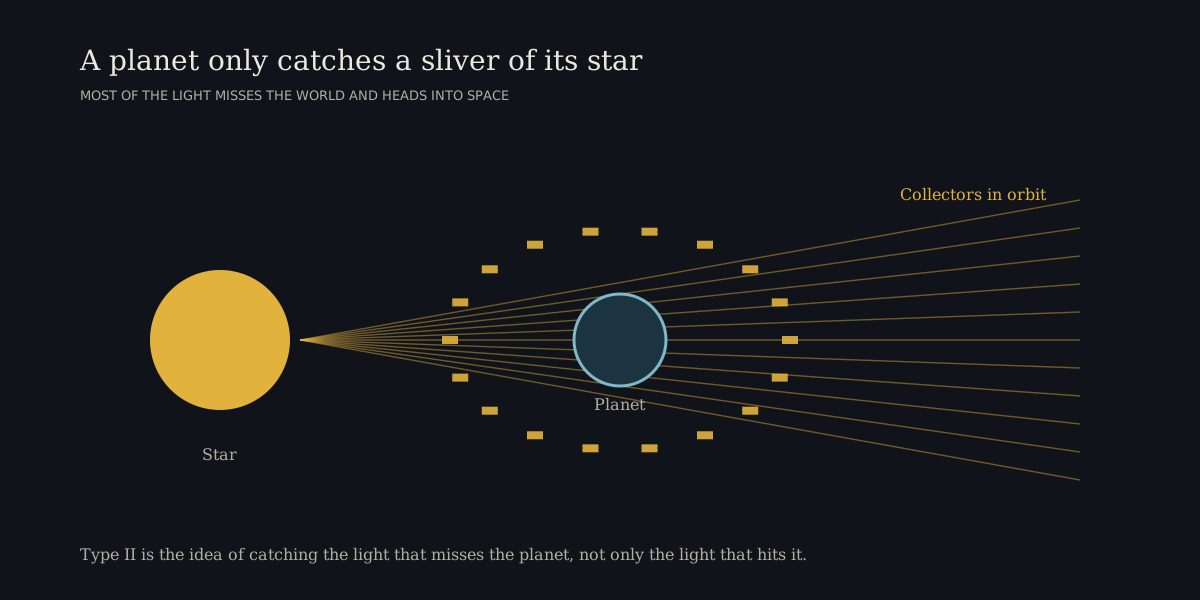
A star pours energy into space all the time, in every direction. Almost all of it misses every planet. A Type II civilization would collect that output rather than living on the thin slice that happens to fall on one world.
The usual picture is not a solid shell. A rigid shell around a star would be hard to keep stable. The picture that holds up is a swarm of independent collectors in orbit, each one turning sunlight into useful power and sending it where it is needed. The swarm can grow a piece at a time. Nothing has to be finished before the first piece does work.
Collecting the energy is only the start. It still has to be converted, stored or transmitted, and put to use. Factories, habitats, and computers do not run on raw sunlight. They run on electricity, heat, and fuels made from that energy. The climb is as much a problem of engineering and industry as it is a problem of astronomy. Robot Motion is about the machines that would do the building. Sentient Cloud is about the computing that would plan and run it.
How Type II sits next to Type I and Type III
On the scale used on this site, each main rung is about ten billion times the last. Type I is on the order of 10^16 watts. Type II is on the order of 10^26 watts, which is also the order of the Sun's output. Type III is on the order of 10^36 watts. Those are enormous jumps. A civilization that has mastered a planet is still a tiny fraction of the way to mastering a star, if you measure by power alone.
Carl Sagan later turned the three types into a smooth decimal scale, so you can talk about fractions such as 0.7 rather than waiting for a clean jump from one type to the next. How the Kardashev scale works walks through that math. Kardashev II keeps the current figures, with sources.
None of this says that every civilization must climb the scale, or that climbing it is automatically wise. It says that if you want a single number for how far a society has gone in turning the energy around it into work, this is a clear one.
A goal, not a countdown
Talking about Type II can slide into a tone of destiny, as if the outcome were booked. It is not. The scale is a measuring stick. People still have to choose what to build, what to leave alone, and how to handle the risks of more power in more hands.
It is still a useful goal to name. It keeps the conversation aimed at energy, industry, and time, instead of at slogans. A civilization that can collect a star's output would have the means to support a large population, to compute at a scale we do not reach today, and to do engineering work that a single planet cannot support. Whether we get there, and how we would live if we did, are open questions. The first job is to understand the distance.
If you want the short version of where we stand now, start with where humanity sits on the scale. If you want the engineering picture, read how a civilization might capture a star's energy.
Common questions
Is a Type II civilization the same as a Type 2 civilization?
Yes. Writers use Roman numerals and Arabic numerals for the same rungs. This site uses both, and treats Type II and Type 2 as the same idea.
Did Kardashev claim that such a civilization already exists?
No. He proposed the types as a way to think about the power a civilization might use, including ones we have not observed. The scale is a classification, not a census.
Is humanity a Type II civilization?
No. On the decimal version of the scale, humanity sits well below Type I, at about 0.73. The remaining climb, even to Type I, is still large. The current figures live on Kardashev II.
Does Type II require a solid shell around a star?
No. A swarm of separate collectors is the usual picture, because it can be built gradually and does not have to stand as a single rigid structure.