Where humanity sits on the scale
The number looks close to Type I if you only glance at the decimal. The watts behind it tell a different story.
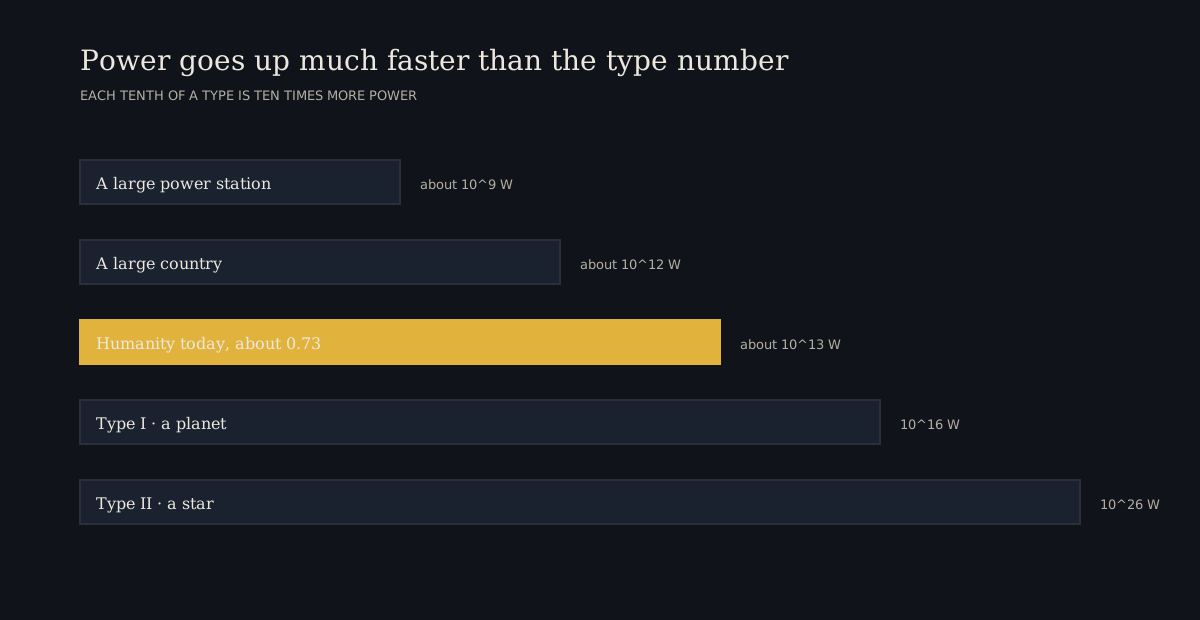
The current reading
On the decimal scale described in How the Kardashev scale works, humanity sits at about 0.73. That figure comes from world energy use of roughly twenty trillion watts. Kardashev II states the underlying energy figure as 600 exajoules in 2025, up 1.7% in a year, from the Energy Institute's Statistical Review of World Energy. Spread over a year, 600 exajoules is about 19 trillion watts.
Plug that into Sagan's formula and you land near 0.73. The type number will not jump in a hurry. Energy use has been rising, but it would have to rise by a factor of several hundred to reach Type I, and by a factor of about ten billion beyond that to reach Type II.
What twenty trillion watts is, and is not
Twenty trillion watts is a large number in daily life. It is a small number next to a star. The Sun's output is on the order of 10^26 watts, about ten billion times 10^16, and many trillions of times what we use now. Even the sunlight that reaches Earth, on the order of 10^17 watts at the top of the atmosphere, is already thousands of times the power we currently run on.
So we are not short of raw solar power at the planet, if the question is physics rather than engineering, cost, and land. We are short of the systems that would collect, convert, and use a much larger share of it, and of the industry that would make those systems at scale. The type number is a compact way to say that.
It is also a global total. It does not tell you how energy is shared between countries, or between people. A single number for the species is useful for the scale and silent about fairness.
Why a few percent a year barely moves the type
A 1.7% rise in energy use is a serious change in the real economy. On a log scale it barely registers. To add 0.01 to the type number you need a rise of about 26% in power, because 10^0.1 is ten and 10^0.01 is about 1.26. To add 0.1 you need a tenfold rise.
That is not an argument for ignoring yearly change. It is an argument for watching both the type number and the raw figures. The type number is for orientation. The exajoules, the watts, and the sources are for tracking. Those live, with citations, on Kardashev II and in How to read world energy numbers.
The remaining climb
Type I, on this convention, is about 10^16 watts. That is hundreds of times what we use now. Getting there would mean a much larger energy system, built from sources we already know and perhaps from sources we are still learning to run, such as fusion. It would also mean handling waste heat, materials, and risk at a scale we have not had to manage yet.
Type II is another jump entirely. What is a Type II civilization? and Capturing a star's energy describe that goal. Nothing about today's 0.73 reading puts that goal on a short timetable. The honest use of the number is to keep the distance in view, and to measure real milestones, such as solar capacity and fusion gain, without pretending they have already closed it.
Common questions
Is 0.73 an official measurement?
No. It is a calculation. You take a published figure for world energy use, convert it to watts, and put it into Sagan's formula. Different energy totals, or a different convention for Type I, will move the number slightly.
Why do some writers say we are closer to 0.7 than 0.73?
Sagan himself placed humanity near 0.7 using the energy figures of his time. As world energy use has grown, the calculated type has edged up. The difference is small on the scale and should not be treated as a precise civic score.
Does this include only electricity?
No. The world energy total used here is primary energy, which includes fuels for heat and transport as well as the energy used to generate electricity. How to read world energy numbers explains the difference.